
Default to Proactive: Escape the Firefighting Trap in Management
How shifting from reaction to prevention transforms your leadership

Servus! I’m Nikolay and this is the fourth issue of the “From Dev to Lead” newsletter. I share practical tips for just-became-managers on how to survive and thrive in a new leadership role. To get issues like this every week, don’t forget to subscribe:
The life of a manager is full of emergencies. Every day, something unexpected happens that can completely derail your plans. At times, planning itself might feel pointless — why bother when you’ll inevitably get pulled into something urgent?
It can feel like your work is entirely out of your control. And if you’re only thinking in terms of direct control over events, it might actually be true.
But does that mean you have no control over the situation? Not at all.
In my previous article on feedback loops, I mentioned the importance of systems thinking. A manager’s job isn’t to jump into every crisis — it’s not about being the best firefighter. And managers aren’t evaluated by how quickly and frequently they react.
Instead, effective leadership is about designing systems that:
Establish structured responses to recurring events
Minimize disruption when things go wrong
Ensure predictable, controlled handling of challenges
Prevent problems from happening in the first place
Sounds a bit abstract? Let’s break it down.
Most “emergencies” aren’t really emergencies
When I say “emergency,” you might picture a production database outage, with thousands of furious customers flooding support. And sure, that qualifies.
But let’s be real—I tend to exaggerate in my posts 😃. The firefighting metaphor might make it sound like I’m only talking about catastrophic failures.
In reality, an “emergency” is simply anything that disrupts your current plan and forces you to shift focus:
A stakeholder requests urgent information
A new input shifts the team’s priorities
Your manager suddenly asks for a report
Another team needs your help
A production bug is discovered
A company-wide meeting drops into your calendar, completely derailing your day (or even a week)
Even routine situations, like a direct report going on unexpected medical leave
In the heat of the moment, we tend to overestimate the importance of these events. Our brains aren’t wired for perfectly rational assessments on the spot.
🧠 Cognitive biases — like recency bias, frequency illusion, salience bias and the planning fallacy skew our judgment. These biases make new events feel bigger than they actually are, pushing us toward reactivity instead of measured responses.
Our brains are inherently irrational — especially when reacting to new situations — and there’s no way to fully override this instinct. But you can manage it.
I might sound like a broken record, repeating the same simple idea across multiple posts. But that’s intentional—because this topic is that important.
We are human beings.
We work with humans.
We create products for humans.
And we should never forget that.

Reactive vs. Proactive
Now that we’ve set the stage, let’s dive into the core idea of this article.
Everything we’ve discussed so far is about reaction — how you respond to unexpected events. Being reactive means acting quickly in response to something urgent.
Is that part of a manager’s job? Sure, sometimes.
But truly effective managers (and employees, for that matter) default to being proactive.
What does that mean?
It means you build systems that react for you—so you don’t have to firefight every single day. Instead of jumping from one crisis to another, you set up processes, structures, and habits.
Here’s how reactive vs. proactive management plays out in real-life scenarios:
Example 1: A stakeholder requests urgent information
Reactive approach: you scramble to gather the information, drop everything to respond, or jump on an unplanned call.
Proactive approach: you anticipate what information your stakeholders need and make it readily available before they even ask.
✅ Systems to support that:
Hold regular sprint reviews and make progress visible
Don’t just share what your team has done — anticipate what your stakeholders actually care about. Focus on impact, not just output.
Set up recurring check-ins with your stakeholders
Maintain a dashboard where stakeholders may find relevant updates on demand
Example 2: A new input shifts the team’s priorities
Reactive approach: immediately abandon the original plan, react to every new input, and try to accommodate all changes without evaluating their impact.
Proactive approach: build a stakeholders map. Understand what is crucially important for your product. Structure a feedback gathering process. Ensure that you are getting all the important market insights and understand your customers.
✅ Systems to support that:
Run sprint reviews. Ensure that you are showing the product to the key stakeholders and requests their input about the market
Before jumping to execution, understand the expected outcome of the project. Analyze the customers audience / portraits to be able to assess the required changes with data
Get deeper into the customer domain, track feedbacks and establish direct channels for insight
Example 3: Your manager unexpectedly asks for a report
Reactive approach: scramble to collect data, involve your team.
Proactive approach: understand how your manager assesses your team’s performance. Gather that data regularly. Make sure it is transparent and is accessible without being asked. Understand how your manager is assessed by his manager.
✅ Systems to support that:
Keep your manager regularly informed. If there is no regular 1:1 planned — suggest to set it up.
Set dashboard (s) that can be checked
Gather data that might be needed regularly
Understand the perspective of your manager to tailor the data to his needs
Example 4: A production bug is discovered
Reactive approach: drop everything and fix the issue immediately. Inform customers once it is resolved.
Proactive approach: assess severity first, fix only if necessary. Analyze what caused the bug. Ensure that your process ensures enough quality of the product. If it is enough — continue operations as usual. If it is not enough — implement changes in the process ensuring more quality.
✅ Systems to support that:
Define a bugs severity matrix to prioritize fixes effectively
Introduce TDD to your process to improve the quality of the product
Introduce a dev-duty rotation, so only one person is handling emergencies while the rest of the team continues the planned work
Perform post-mortems on critical bugs — conduct a retrospective analysis to understand the root cause and prevent occurrences
Distractions are endless. The key to being proactive is identifying which ones are predictable and either preparing structured responses or preventing them altogether:
Most communication issues can be solved by proactive transparency
Most quality issues can be solved by improving the software development process (not just adding testing, please!),
Most urgent report requests can be eliminated by understanding what stakeholders need and providing the data upfront.
Most so-called emergencies aren’t true emergencies. They can wait until the next iteration of the cycle. By implementing structured cycles (e.g., sprint reviews, bi-weekly check-ins, automated reporting), you remove daily distractions and regain control.
And for the rest?
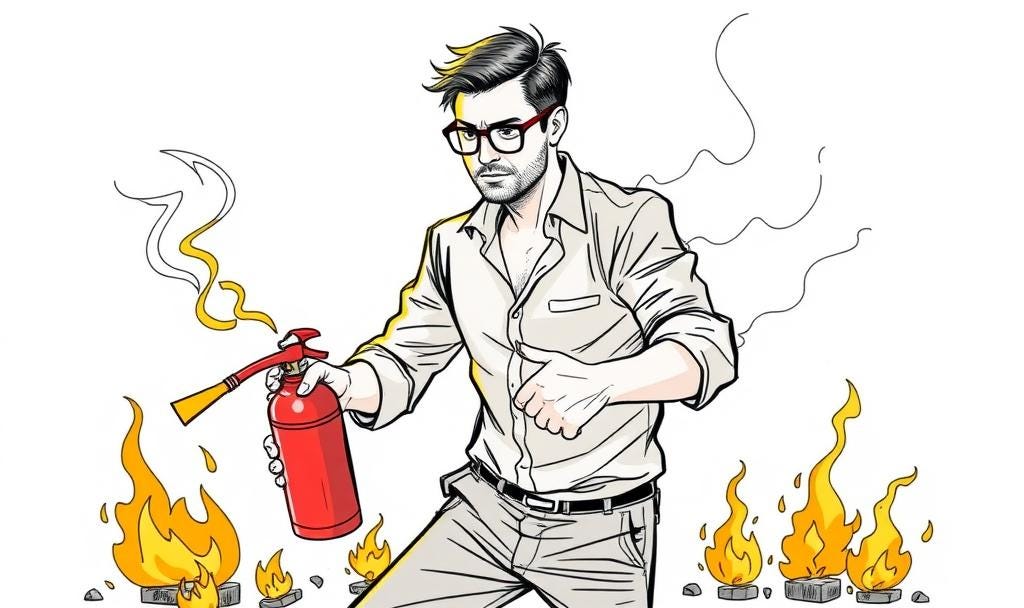
Some things truly are emergencies. You can’t prevent them all, so yes — sometimes, you’ll need to roll up your sleeves, grab a fire extinguisher, and put out the flames.
But if you find yourself firefighting every single day?
Then the real problem is the system itself — and as a manager, fixing that is your actual job.
Final thoughts
Management is about building systems, not just solving problems.
You might be the best firefighter in your company, but that won’t help you grow as a leader. True leadership isn’t about reacting quickly—it’s about designing a system that runs smoothly without your constant intervention.
This article focused on the shift from reactive to proactive management, but I barely scratched the surface of systems thinking. I’ll dive deeper into that in future issues.
In the meantime, if you want to explore this topic further, here are a few books I highly recommend:
📖 Ray Dalio — Principles: Life and Work — A fascinating look at how an investment firm owner built systems that could function beyond his direct involvement.
📖 Donella H. Meadows — Thinking in Systems — An excellent introduction to systems thinking and how to see the bigger picture.
📖 Peter M. Senge — The Fifth Discipline — A must-read on learning organizations and building self-sustaining systems.
I hope these books open new horizons for you.
Take notes. Build systems. And above all — stay curious.
We’ve got this. Together 🚀
Thank you for reading. Don’t forget to subscribe to From Dev to Lead to stay tuned for future issues.